
Get Started

The Typical School Network

For each of the three main pieces of a typical district network, the FCC has adopted connectivity standards. Scroll over network diagram for connectivity goals.

Thank you for reading this post, don't forget to subscribe!

Robust broadband that fully supports digital learning requires that each part of a district’s network be working in unison and at full capacity. If one or more of the pieces of the network is broken or underperforming, then high-speed broadband and therefore rich, digital learning content cannot reach students’ devices.
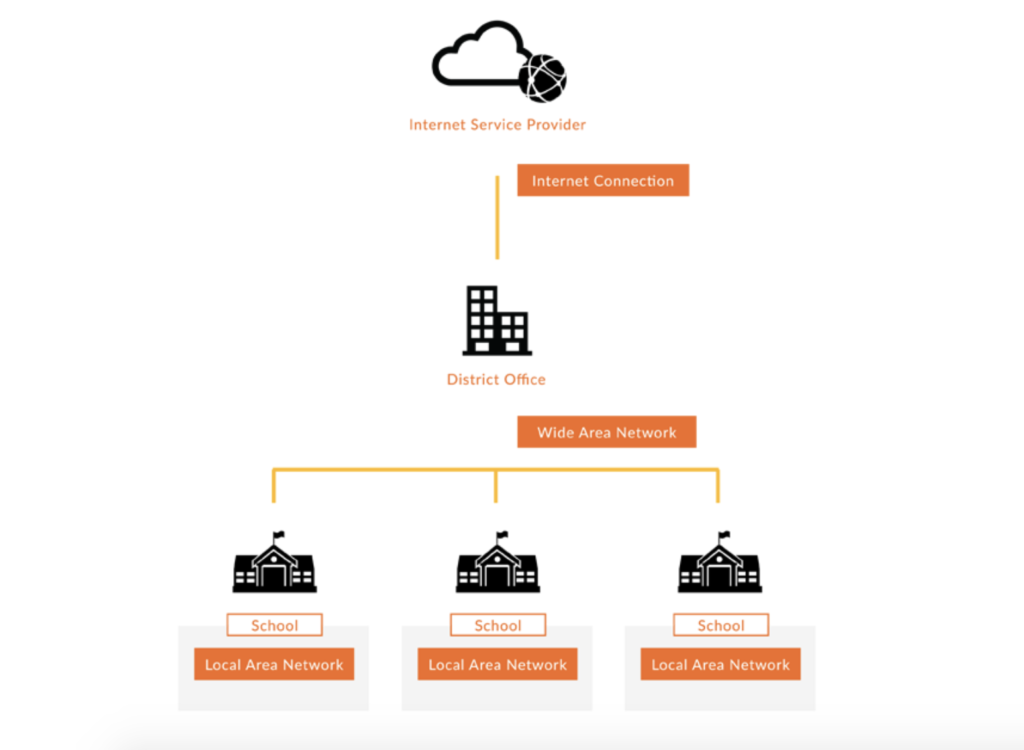


School District Network

Three Prerequisites to Improving School Connectivity

1

Every school needs access to fiber.

Every school needs a fiber-optic (or alternative scalable bandwidth) connection. It is the most cost-effective way to deliver high-speed connectivity. Districts with fiber connections on average have 10x more bandwidth.

2

Bandwidth must be affordable.

The cost of broadband access has continuously decreased since 2013.  From $22 per Mbps in 2013, the cost of broadband today is at $2.25 per Mbps. However, affordability still remains a challenge for school districts as there continues to be significant variation in what districts pay for Internet access, especially for higher-bandwidth circuits.

3

Every classroom must have robust Wi-Fi.

Wireless technology allows for connectivity to reach all the way to students’ devices and enables the rich digital learning that can transform our education system. The FCC has allotted $150 per student over the course of 5 years from 2014-19 totaling to over $5B in available funds to upgrade internal networks in every classroom.